
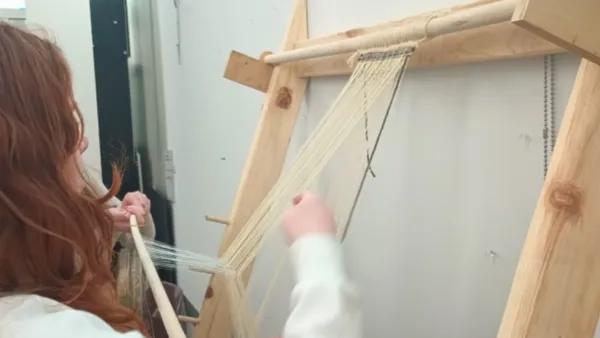
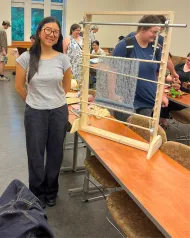
In a vibrant celebration of craft, scholarship, and experimentation, students in Ancient Mediterranean Textile Production capped off their semester with an Open Studio Show on Tuesday, April 29th, showcasing a semester’s worth of hands-on work that traced the threads of ancient textile traditions.
Offered through the John and Penelope Biggs Department of Classics and taught by PhD student Bayla Kamens, the course invited students to learn not just about ancient textiles, but with them—through immersive, tactile engagement with the materials, methods, and meanings of fiber production in the ancient Mediterranean. The course was made possible by the Suzanne Mizera and James Risch Fund, which supported everything from wool combs and loom weights to student materials for final projects.
Starting with raw flax and wool, students learned to process, spin, dye, weave, and finish their own textiles using ancient techniques. Posts throughout the semester on the @wustltextiles feed chronicled their journey: from making drop spindles and combing wool, to experimenting with plant-based dyes like madder and weld, to constructing garments inspired by those worn in Pharaonic Egypt, Classical Athens, and Imperial Rome.
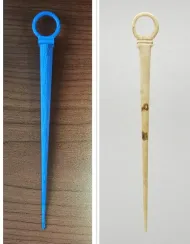
The course paired scholarly inquiry with creative process. Readings and discussions explored the economics of textile labor, symbolism of colors and patterns, and literary references to cloth and clothing. A highlight of the semester included a visit to the WashU Tech Den, where students designed and 3D-printed their own spindle whorls and distaffs—modern technology brought to bear on ancient tools.
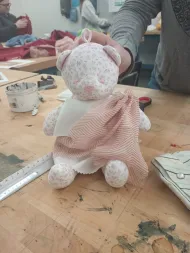
Each student culminated their learning in a final project, selecting a specific area of textile production to investigate deeply. Some recreated ancient dye recipes; others built warp-weighted or tablet looms; still others reconstructed specific historical garments. The Open Studio gave students the opportunity to share their findings with the public and demonstrate their techniques in action.
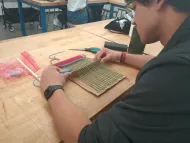
Thanks to the Mizera-Risch Fund, the course was fully equipped with fiber combs, spindles, yarn, natural dyes, loom weights, and other tools. Students were also given micro-grants to support their final projects, allowing them to pursue ambitious and original ideas.
The Open Studio brought together classmates, faculty, friends, and guests in a celebration of hands-on humanities. With every woven panel, hand-dyed skein, and reconstructed chiton, the students reminded us that history is not only something we read—it’s something we make.
For those interested in exploring the students' journey and creations further, additional information and updates are available on their Bluesky profile: wustltextiles.bsky.social.


