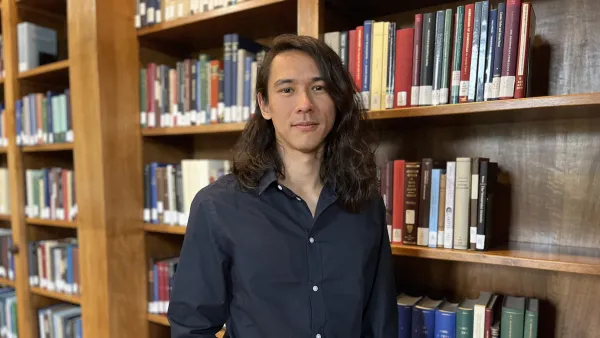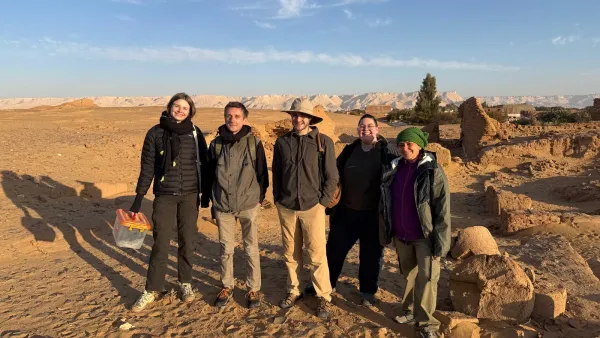
This winter, Aaron Held, M.A. student in Classics, reached a long‑held academic milestone when he traveled to Egypt to participate in the Amheida Project excavations in the Dakhleh Oasis. His season in Egypt was supported by both the Penelope Biggs Travel Award and the Suzanne Mizera and James Risch Fund, funding Aaron describes as “monumental to my development as a graduate researcher.”
Aaron’s interest in the archaeology of Roman Egypt began during his junior year as a WashU undergraduate. “In my junior fall… I took Professor Nicola Aravecchia’s seminar Rome in Egypt: The Archaeology of an Oasis City, which first inspired my interest in the archaeology of Roman Egypt and, in particular, the site of Amheida,” he explained. From that point on, joining the excavation team became one of his primary academic goals. “Being able to take part this season marked an important milestone in my education as an archaeologist of Roman Egypt.”
Cairo and the Fayum: Bringing Coursework to Life
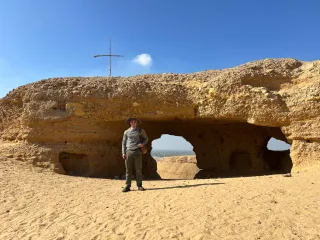
Aaron began his 2026 season with a series of research trips based in Cairo. He visited the Coptic Museum on consecutive days, where seeing artifacts from sites he had studied—such as the Monastery of Apa Jeremias at Saqqara and the Monastery of Apa Apollo at Bawit—was deeply meaningful. He also made two day trips to the Fayum, visiting Medinet Madi, a Graeco-Roman city offering insights into Hellenistic urbanization, and Naqlun, a vast late antique monastic landscape.
At Naqlun, Aaron encountered environments he had read about for years but never seen in person. “Experiencing firsthand the contrast between the sun-soaked shale cliffs and the cool, shaded interiors of the cells overlooking the limitless bright green of the Fayoum Oasis materialized the impressive engineering and environmental exploitation that I had previously encountered only through readings and lectures,” he wrote.
He added that seeing how Egyptian monastic communities occupied “liminal spaces—here, the cliffs at the edge of an oasis—yet ones still hospitable and very much still a part of a larger economic ecosystem” directly enriched a central question in his own research.
Excavating at Amheida
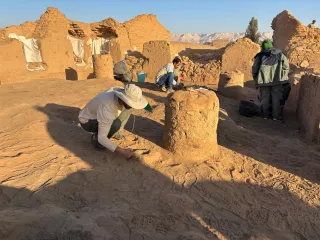
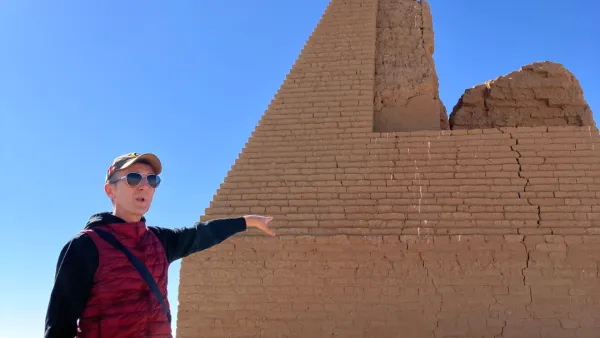
On January 7, Aaron joined Professor Aravecchia, Washington University peers, and the larger international team in the Dakhleh Oasis as excavation at Amheida began. He quickly integrated into the daily workflows of the mission: excavation, documentation, photography, organization, and topographical survey.
Aaron worked across several areas of Building B10, but his primary focus became Room 7, a large colonnaded space whose stratigraphy raised promising questions about the city’s post-abandonment phases. “Room 7… raised compelling questions about post-abandonment activity at the site,” he noted—questions he plans to continue exploring.
The season also sparked a new research direction for him: ostraka. “I developed a strong interest in the ostraka recovered during the season—texts recording names, rents, and transactions—and I am continuing to work with these materials remotely,” he wrote.
Continuing the Work
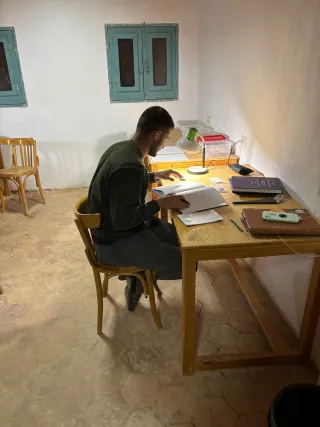
Even after returning from Egypt, Aaron’s involvement with the project continues. He plans to contribute throughout the spring and summer to the Amheida GIS transition project, applying skills he developed during the excavation season.
Reflecting on the impact of his funding, Aaron expressed deep appreciation: “This sustained training and research experience was made possible by the support of your fund, and it has been monumental to my development as a graduate researcher.”
The John and Penelope Biggs Department of Classics congratulates Aaron on his exceptional work and is proud to support the opportunities that continue to shape his path as a scholar of Roman Egypt.