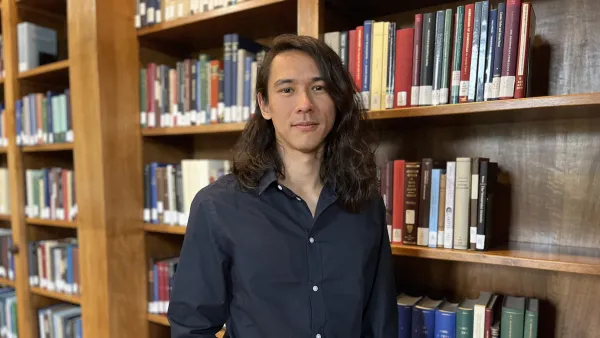
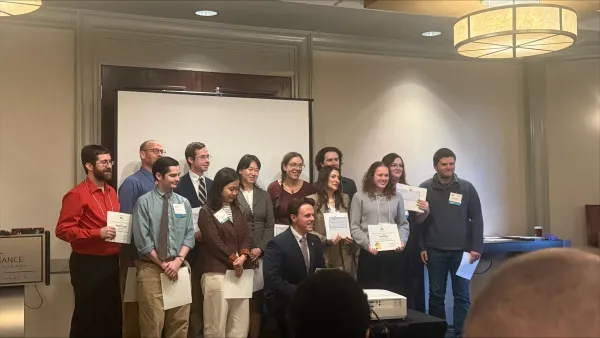
Earlier this semester, Classics MA student Zhiyuan Wang traveled to Vancouver to present their research at the interdisciplinary conference Bodies and Embodiment at the University of British Columbia. Supported by the Robert Lamberton Award, Zhiyuan shared new work on choral performance in Euripides’ Electra, engaging with scholars from across North America whose research intersects with ancient religion, performance, and philosophy.
In the reflection below, Zhiyuan offers insight into their presentation, the scholarly conversations that emerged during the conference, and the ways the experience will continue to shape both their research and teaching.
Read Zhiyuan’s full reflection:
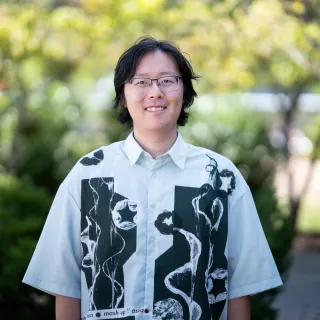
At the conference Bodies and Embodiment, I delivered a presentation on choral performance in Euripides’ Electra. My paper explored the strikingly dense imagery of music and dance in the choral odes and the play’s unorthodox rejection of Apollo’s oracle at the conclusion. Approaching the play through a body-centered phenomenological framework, I sought to reconstruct the nonverbal dimensions of communication embedded in choral performance—gesture, movement, and collective bodily expression—which often remain invisible in purely textual analysis. The presentation was well received, and the discussion that followed introduced me to several peers working on related topics, including mystery religions, embodied emotion, and conceptions of the soul’s body in Platonic philosophy. These conversations were especially stimulating, as they revealed a shared scholarly interest in how ancient texts imagine the body as a site of religious and emotional experience.
The conference also resonated strongly with my teaching experience as a teaching assistant at Washington University in St. Louis. The keynote lecture examined the role of the body in articulating divine justice and socially situated notions of truth, drawing on evidence from Asclepieion healing inscriptions, curse tablets, and the Bible. The talk immediately reminded me of themes explored in the Ancient Magic and Ancient Medicine course I assisted with at WashU. One particularly provocative idea from the lecture—that in antiquity death was not necessarily conceptualized as the end of bodily experience—offered a powerful lens through which to reconsider religious testimonies preserved in these sources. Hearing these materials discussed in a broader comparative framework reinforced for me how questions of embodiment cut across different genres of ancient evidence, from literature and philosophy to ritual practice and healing cults.