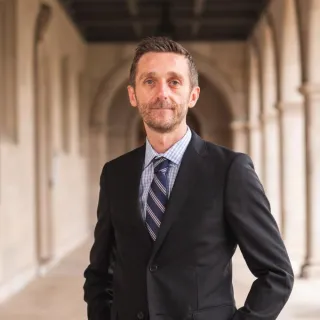
While on sabbatical this academic year, Nicola Aravecchia, associate professor of Classics and of Art History and Archaeology, continues to share cutting-edge research with international audiences. On March 18, 2026, Aravecchia presented a seminar at the Centre for Classical Studies at the Australian National University (ANU) in Canberra, showcasing the latest findings from his long-running archaeological fieldwork in Egypt’s Western Desert.
The seminar, titled “Life in a Desert City: New Discoveries from Ancient Trimithis (Egypt’s Western Desert),” was part of ANU’s Centre for Classical Studies Research Seminar Series, a forum that brings together scholars from around the world to discuss new approaches and discoveries in the study of the ancient Mediterranean and Near East.
Revealing Life at the Edge of the Roman World
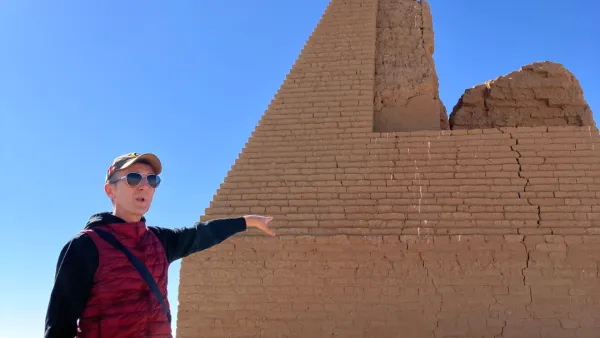
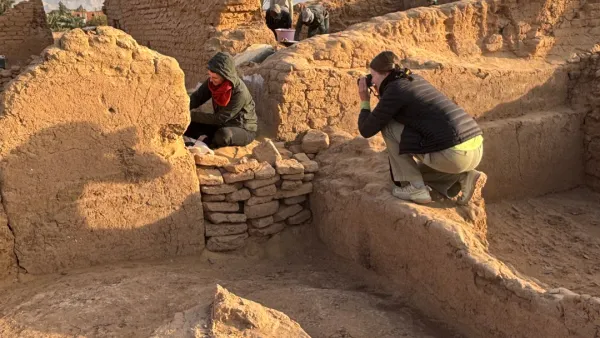
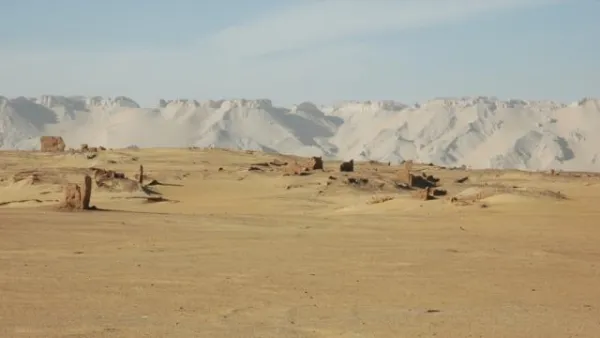
Aravecchia’s lecture focused on Trimithis, a Graeco-Roman city located at modern Amheida in Egypt’s Dakhla Oasis, a remote but surprisingly vibrant urban center during Late Antiquity. Drawing on more than two decades of excavations at the site, he presented results from the most recent field season that deepen scholars’ understanding of daily life, architecture, and cultural interaction far from the empire’s political centers.
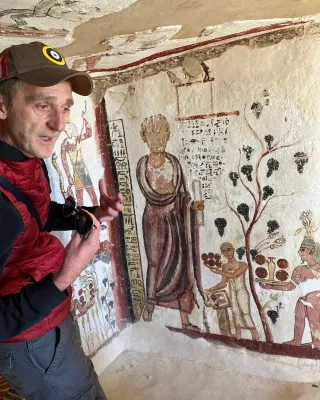
Among the highlights discussed were the excavation of a large third- to fourth-century elite house, notable for its monumental architecture and richly preserved wall paintings, as well as investigations in a previously unknown sector of the city that has been revealed through the gradual shifting of desert sands. Together, these discoveries are reshaping scholarly views of Trimithis’s urban layout, social structures, and economic vitality.
Aravecchia emphasized that, despite its location deep in the Western Desert, Trimithis was closely connected to the wider Mediterranean world, participating in shared artistic, architectural, and cultural traditions. The city’s material remains underscore both the prosperity and the complex cultural horizons of its inhabitants during the Roman and late antique periods.
A Global Stage During Sabbatical
The ANU seminar reflects Aravecchia’s active and productive sabbatical, during which he has continued to balance fieldwork, writing, and international scholarly engagement. His invitation to present in Canberra highlights the global reach of research being conducted within WashU’s Department of Classics and Department of Art History and Archaeology, as well as the central role of interdisciplinary collaboration in contemporary archaeological scholarship.
Strengthening WashU’s International Presence
Aravecchia’s seminar at ANU underscores Washington University’s strong international profile in the humanities and the importance of sustained field research for advancing knowledge of the ancient world. As he continues his sabbatical, his work in Egypt—and presentations like this one “Down Under”—demonstrate how WashU faculty are expanding the boundaries of classical and archaeological scholarship far beyond campus.