
With support from the Penelope Biggs Travel Award, Dr. Elizabeth Hunter (Performing Arts Department) traveled to Rome, Pompeii, and Herculaneum in summer 2025 to explore cutting-edge uses of augmented and virtual reality at ancient Roman heritage sites. This fieldwork will inform a chapter of her second book, Death Is Obsolete: Staging Resurrection in the Age of AI, which investigates how spatial computing and performance theory intersect in the phenomenon Hunter calls “digital resurrection.”
Over the course of her research, Hunter visited four key sites that exemplify the use of immersive technologies to digitally reconstruct ancient environments for contemporary audiences:

Domus Romane at Palazzo Valentini (Rome)
Circo Maximo Experience (Rome)
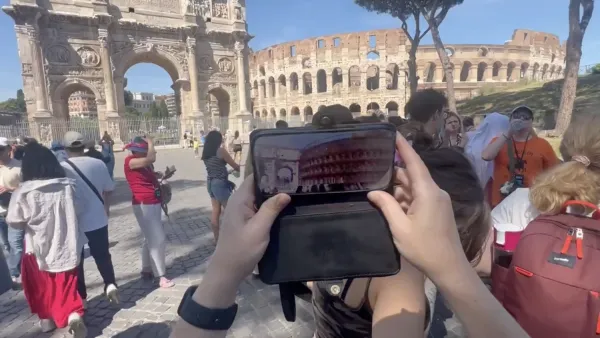
Vivid Walks AR App for the Colosseum (Rome)
ARTour AR Tour at the Archaeological Park of Pompeii
Each installation offered a unique model of how digital content—whether superimposed onto physical ruins (AR) or fully immersive (VR)—can animate the past in new ways. “I expected this research would be valuable,” Hunter reflects, “but I didn’t anticipate how dramatically it would clarify and reshape my thinking about this chapter on digital resurrections of architectural bodies.”
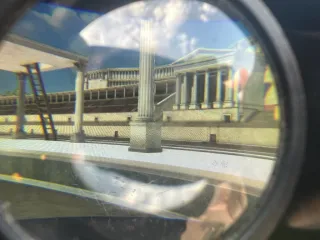
The Domus Romane, buried beneath a Renaissance palazzo near Trajan’s Column, combines guided tours with full-room multimedia projections that envelop visitors in imagined reconstructions of two ancient Roman homes. In contrast, the Circo Maximo Experience allows guests to explore independently using a wearable headset that delivers AR content anchored to specific points across the historic site.
The Vivid Walks mobile app brings a more accessible, self-guided approach to AR at the Colosseum, using a smartphone camera to trigger visual overlays of the structure’s past appearance—without the need for special equipment or partnerships with site managers. Finally, ARTour in Pompeii pairs lightweight AR glasses with a human guide, allowing for more flexible navigation of crowded archaeological areas while offering rich visualizations of ancient spaces.
Hunter noted the surprising sophistication of these tools: “From afar, I worried they might feel gimmicky. But in person, they proved deeply effective in reimagining how visitors can experience antiquity in the twenty-first century.” Her work now moves into a writing phase, with this fieldwork forming the foundation for a chapter comparing these models of “resurrected” space.
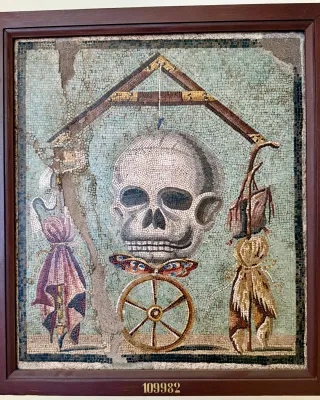
The research trip also yielded an unexpected creative inspiration: a potential book cover. During a visit to the National Archaeological Museum of Naples, Hunter encountered a mosaic titled Memento Mori, which depicts death as the great equalizer. “It feels like the perfect visual counterpoint to a book called Death Is Obsolete,” she notes.
The Department congratulates Elizabeth Hunter on this innovative and thought-provoking research, and thanks the Penelope Biggs Travel Award for making it possible.