Vedul Palavajjhala, a senior Classics major, returned from the 2025 Society for Classical Studies (SCS) Annual Meeting in Philadelphia, held January 2–5, with a renewed sense of purpose and inspiration for his research. Supported by the Mizera-Risch Fund, Vedul attended a wide range of scholarly sessions that deepened his engagement with cutting-edge classical scholarship, particularly in digital and interdisciplinary approaches to the ancient world.
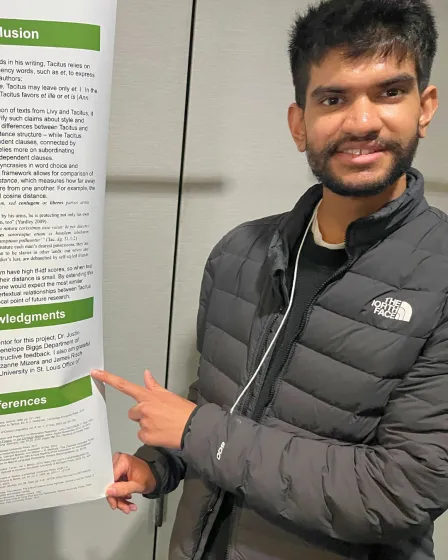
Reflecting on his experience, Vedul highlighted how the conference broadened his perspective on the role of technology in Classics. “Thanks to the generosity of Dr. Suzanne Mizera and James Risch, I was able to participate in discussions at the forefront of classical scholarship,” he said. “This opportunity was instrumental in shaping my understanding of how interdisciplinary tools—especially artificial intelligence—can transform our approach to ancient texts.”
One of the most impactful sessions for Vedul was Opening Up Classics with AI, which explored the potential of artificial intelligence to enhance classical research and pedagogy. Dr. Samuel Huskey’s presentation showcased how deep learning models, trained on data from the Digital Latin Library, could assist in standardizing bibliographical data—an otherwise time-consuming task for scholars.
Equally compelling was a paper by Dr. Gregory Crane, which examined the use of generative AI models such as ChatGPT for translation and linguistic analysis. Dr. Crane demonstrated how these tools can assist both students and researchers—helping beginners parse Latin forms and enabling advanced scholars to translate texts like Classical Persian for broader comparative studies.
Perhaps most valuable for Vedul, however, was the one-on-one conversation he had with Dr. Crane following the session. “We discussed my own work on using machine learning to analyze stylistic features of Latin historians,” Vedul explained. “Our conversation opened up new possibilities for using models like GPT-4o to reconstruct linguistic features in damaged or fragmentary texts—an area that could significantly advance scholarship.”
Vedul left the meeting not only with new knowledge but with a challenge: to think critically about the applications and limitations of AI in classical scholarship. “This experience sharpened how I present my own research, especially at other academic venues like the University of Tennessee’s Classics conference and CAMWS,” he said.
As he prepares to begin a PhD program in the fall, Vedul expressed his gratitude to the Mizera-Risch Fund and committee for making this opportunity possible. “I will cherish this experience as a pivotal moment in my academic journey,” he said.