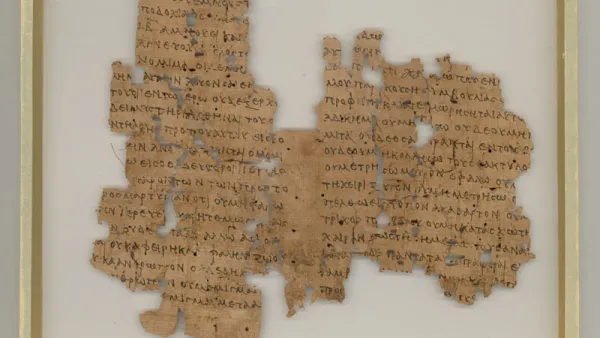
A fragment from Washington University’s papyrus collection has been included in History of Incarceration, a wide-ranging digital documentary project that explores how societies across time have documented and enforced systems of justice, detention, and social control.
The WashU papyrus, designated as Documentary D100, is part of the university’s collection of over 400 ancient fragments excavated in Oxyrhynchus, Egypt, in the early twentieth century. The document records a legal proceeding connected to carceral practices in Roman Egypt—offering a rare glimpse into how incarceration was administered nearly two millennia ago.
Preserving the Ancient Record
WashU’s papyri collection, owned by the Department of Classics and stewarded in Olin Library’s Special Collections, dates from the first century BCE to the eighth century CE. The texts include everything from personal letters and receipts to leases, tax records, and legal documents like the incarceration order now highlighted in the History of Incarceration project.
In recent years, the collection has undergone extensive conservation and digitization, thanks to the work of faculty, graduate students, and international collaborators. Fragile pieces have been cleaned, rehoused in protective glass, and captured through high-resolution and infrared photography. This work not only secures their preservation but also expands access for scholars and students around the world.
Connecting Past and Present
The History of Incarceration project brings together documents spanning cultures and centuries to highlight the historical depth of carceral systems. The WashU fragment contributes to this effort by showing how the machinery of confinement was formalized in everyday life in antiquity.
For WashU Classics, the collaboration reflects the department’s commitment to bringing ancient texts into dialogue with contemporary issues. As the papyri continue to be published, digitized, and studied, they provide opportunities for students and the broader public to encounter ancient history not as something distant and closed off, but as an active resource for understanding enduring human questions.