
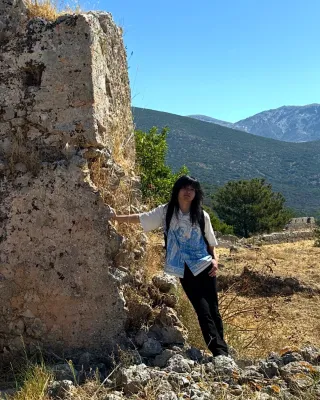
This July, Classics major Elio Sun took part in a bioarchaeological field school in Preveza, Greece—ancient Nikopolis—thanks to travel funding provided by the Department of Classics and its generous donors. The experience offered Elio a unique opportunity to apply classroom learning to hands-on archaeological research.
Earlier in the spring semester, Elio completed two advanced seminars in classical archaeology with Professor Aravecchia, including one focused on church burials in Late Antique Egypt. “That class gave me a framework for thinking about burial practices and their social meanings,” Elio said.
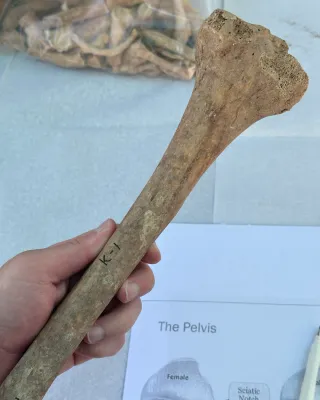
During the field school, Elio worked with Byzantine skeletal remains excavated from local basilicas. “I learned to identify and catalog bones, and some belonged to women—likely patrons, not clerics—whose burials reflected their status in the community,” Elio explained.
Elio emphasized how the fieldwork brought academic concepts to life: “It was exciting to see how what I learned at WashU helped me interpret real archaeological finds. It made the past feel tangible.”
The Department congratulates Elio on this achievement and thanks all donors who make such transformative experiences possible for our students.


