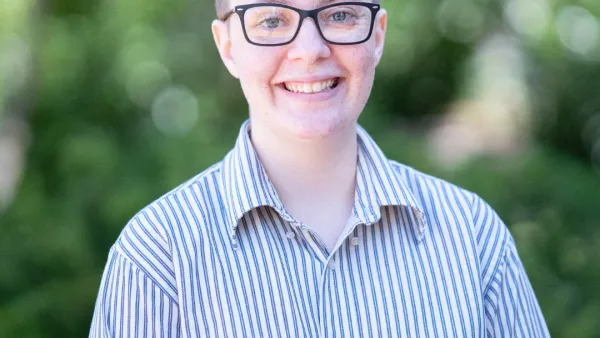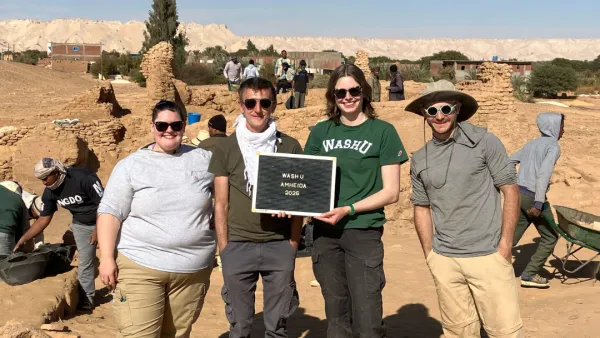
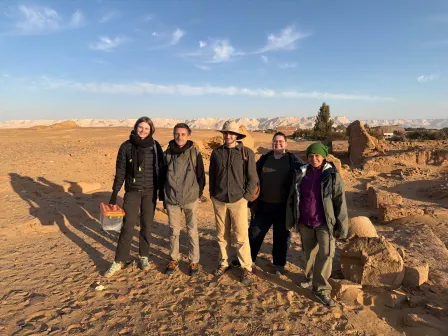
Fourth-year PhD student Claire Lyman (Art History & Archaeology) returned from the 2026 excavation season at Amheida with a deep sense of gratitude and excitement for the future of her research. Supported by the Penelope Biggs Travel Award, Claire joined Professor Nicola Aravecchia’s archaeological team for several weeks of fieldwork in Egypt’s Dakhla Oasis—an experience she describes as both academically enriching and personally inspiring.
“I first want to express my utmost gratitude to John Biggs for providing me with the truly amazing opportunity to participate in Professor Nicola Aravecchia’s excavation at Amheida,” Claire shared. After studying the site in Aravecchia’s 2023 seminar Rome in Egypt: The Archaeology of an Oasis City, she was eager to see the oasis city firsthand. “It was amazing to experience the site itself and to have played an active part in the production of future scholarship as finds from this season are published.”
A Perfect Fit for Her Research
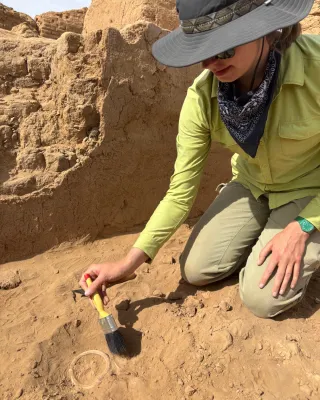
Claire’s doctoral work focuses on Roman domestic art, making this season’s excavation especially meaningful. The team’s major focus—Building 10 (B10), a Roman house—aligned directly with her interests.
“During the 2026 season the archaeological team is working on uncovering a house… which was perfectly aligned with my interests,” she explained. Beyond excavation, Claire gained insight into the rigorous documentation required for archaeological research. “I learned so much about the ins and outs of archaeology (lots of documentation!).”
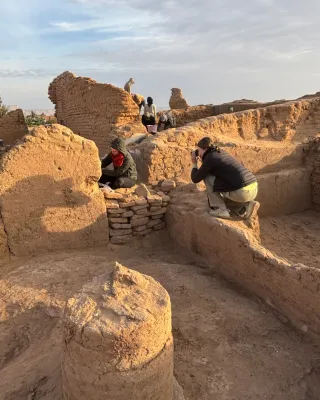
For Claire, whose scholarly work often takes place in archives and libraries, the collaborative nature of fieldwork was a welcome shift. “The life of an art historian is often solitary… so to have the opportunity to work on a team in the field was so rewarding,” she reflected. She also cherished the camaraderie of the field crew, adding, “I will miss my colleagues, many of whom I was able to practice speaking Italian and Egyptian Arabic with.”
Guided by a Supportive Team
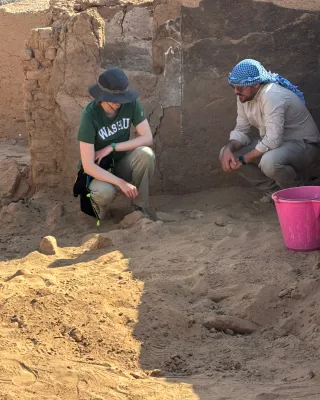
Claire praised the leadership of field director Professor Nicola Aravecchia and deputy field director Stefania Alfarano, noting that they “facilitated a welcoming environment for the WashU students.” Students rotated through different rooms of House B10 to gain diverse experience working with multiple archaeologists and stratigraphic contexts.
Her rotation also included time in Area 11, a newly exposed zone on the western edge of the site. “The purpose and origin of the buildings at Area 11 are a mystery,” she wrote, describing the area’s two uniform streets and unusual layout as “fascinating.”
A Season to Remember
Salento).
As the 2026 season continues, Claire reflects with appreciation and excitement about what lies ahead for Amheida and for her own research trajectory. “All this is to say is that the 2026 season… is an extremely interesting one, and I am so lucky to have been a part of it.”
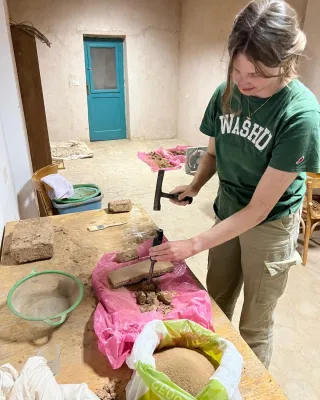
Processing mud bricks to be made into mortar for the conservation of the wall paintings in House B10.
The Biggs Department of Classics congratulates Claire on her outstanding work and is proud to support the experiential learning that shapes future scholarship.