
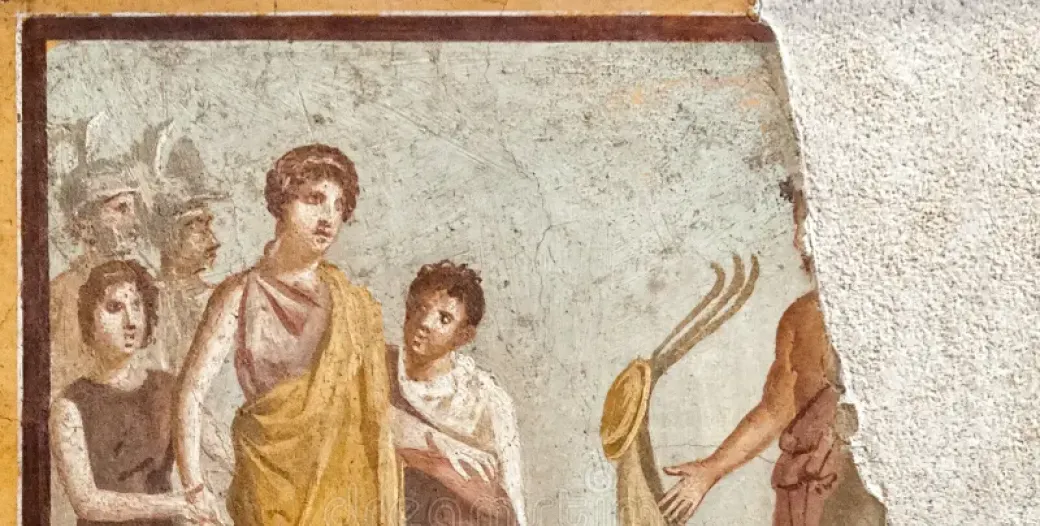
Chryseis, Philoctetes, and the Making of the Homeric Iliad
Co-sponsored by The John and Penelope Department of Classics and the Program in Linguistics
Online lecture; in-person watch party with snacks in Seigle 301.
Zoom Link
Click here to enter the Zoom lecture hall. Note: You will be admitted into the Zoom lecture when it begins.
Having tech issues? Email gazzola@wustl.edu.
Abstract
The story of Chryseis as narrated in Iliad 1 is constructed from myths that are relevant to two myths about the hero Philoctetes, who is mentioned only once in “our” Iliad but who is well-known to experts in Greek myths on the basis of a tragedy by Sophocles, in which Philoctetes suffers from the bite of a noxious snake. In one version of this myth, closely associated with a group of Greeks called Aeolians, the bite happened on an island named Chryse, where the local goddess of the island was also named Chryse. In another version of the myth no connection is made with an island or a goddess named Chryse, but there is an indirect connection with the negative aspects of the Trojan War. The most telling sign of this indirect connection is the Aeolian name of the woman Chryseis, who in Iliad 1 is the daughter of a priest named Chryses. All these connections reveal some basic truths about the construction of the Homeric Iliad as we know it.
This lecture is meant for both non-experts and experts in Homeric poetry.
Non-experts will benefit from reading before the lecture Professor Nagy’s “plot-outline” of Iliad 1 (https://continuum.fas.harvard.edu/an-outline-of-the-homeric-iliad-desig…).
Both experts and non-experts may wish to read the following works by Professor Nagy:
Nagy’s comments on Aeolians in his compressed commentary on the Homeric Iliad and Odyssey (https://continuum.fas.harvard.edu/a-sampling-of-comments-on-the-homeric…; search for “Aeolian” and look for “anchor comments” on their traditions).
“Glimpses of two different myths about two different visits by Philoctetes to the sacred island of the goddess Chryse.” https://continuum.fas.harvard.edu/glimpses-of-aeolian-traditions-in-two….
“Sappho’s Aphrodite, the goddess Chryse, and a primal ordeal suffered by Philoctetes.” https://continuum.fas.harvard.edu/sapphos-aphrodite-the-goddess-chryse-….
“How myths that connect the hero Philoctetes with the goddess Chryse are related to myths about a koúrē ‘girl’ named Chryseis in the Homeric Iliad.” https://continuum.fas.harvard.edu/how-myths-that-connect-the-hero-philoctetes-with-the-goddess-chryse-are-related-to-myths-about-a-koure-girl-named-chryseis-in-the-homeric-iliad/.

Professor Gregory Nagy's special research interests include archaic Greek literature and oral traditions. His ongoing goal is to integrate his research with collaborative as well as intergenerational mentorships and public engagement initiatives, especially in the context of his Harvard College and Harvard DCE courses on the ancient Greek hero (with almost 10,000 alumni), and his HarvardX MOOC, which has enrolled over 181,000 learners since its launch in 2013. His recent monographs include The Ancient Greek Hero in 24 Hours (HUP 2013) and Masterpieces of Metonymy: From Ancient Greek Times to Now (HUP, fall 2015).