
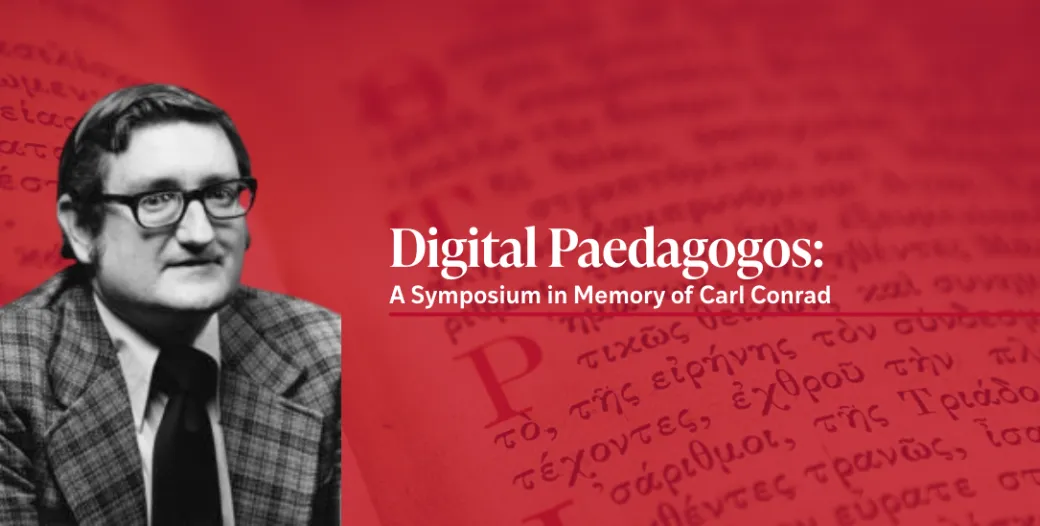
Digital Paedagogos: A Symposium in Memory of Carl Conrad
Co-sponsored by the Humanities Digital Workshop and Religious Studies
The John and Penelope Biggs Department of Classics will be honoring the memory of Carl Conrad with a symposium. All are welcome to attend, and those unable to join are invited to share their reminiscences by emailing Tim Moore (tmoore26@wustl.edu).
Please RSVP if you plan to attend in-person, virtually, or would like to share a remembrance.

Guest Speakers
Helma Dik
Parallel Lives: Word Order and Beyond
Abstract
From an early interest in the study of word order to large-scale outreach efforts, the parallels between Carl Conrad’s career and my own efforts are hard to miss. In this paper, I will briefly discuss the intellectual environments that shaped our work in linguistics, and go on to speculate about the attractions of pedagogical outreach for privileged denizens of Midwestern Ivory Towers.
Helma Dik is an Associate Professor in the Department of Classics at the University of Chicago. Her research centers on Classical Greek linguistics, with a particular focus on syntax, semantics, and pragmatics, as well as stylistic analysis in authors such as Herodotus, Demosthenes, and Sophocles. She is deeply involved in Digital Humanities, contributing to projects like Logeion and collaborating with the Perseus Project to develop corpus-linguistic tools for Greek and Latin.
Her long-term goal is to produce a reference grammar of Classical Greek that reflects modern linguistic developments. She also explores topics such as automated parsing algorithms, gendered language in drama, and text mining approaches to ancient texts. Professor Dik regularly teaches courses on Greek prose, oratory, and digital philology, and has supervised innovative dissertations combining Classics with computational methods.
Patrick Burns
Patterns of word-order in Latin epic, cont. (Ovid and everything after)
Patrick J. Burns, Institute for the Study of the Ancient World, New York University
Abstract
Carl Conrad, in his 1965 article “Traditional Patterns of Word-order in Latin Epic from Ennius to Vergil” (Harvard Studies in Classical Philology 69), shows how Latin epic poets build constructively and creatively on their Greek predecessors through their arrangement and patterning of adjective-noun pairs in hexameter lines. The scope of the work is ambitious—covering Ennius, Cicero, Lucretius, Catullus, and Vergil—and necessarily so, if the work is to pronounce broadly upon (253) “the Roman transformation of Greek traditional forms into strict and elaborate patterns.” And in that respect, the work offers a provocation and invitation to today’s computational literary critic—what can we say about the continuity of Latin epic “transformation” beyond Virgil? Recent computational developments in the areas of Latin sentence parsing, part-of-speech tagging, and metrical analysis make it possible for us to even consider working on such quantitative and formal literary critical questions at corpus scale, in this case on Latin epic poetry from Ovid (1st-cent. CE) to Thomas May (17th cent.). In particular, in this paper, I catalog and trace the continued development of “golden lines”—that is hexameter lines with specific noun-adjective interlocking word order—in sixteen centuries of Latin epic poetry as well as a variation on this pattern that Conrad refers to as “concentric” framing. I use this case study to highlight how bold “Traditional Patterns” was in the pre-computational research environment of the mid 1960s, while also demonstrating how the article continues to offer a model of how systematic, feature-driven literary criticism can be pursued in Latin poetic studies.
Patrick J. Burns is Associate Research Scholar for Digital Projects at the ISAW Library and Research Associate Professor at NYU. His work bridges Classics, computational philology, and digital humanities, with a focus on Latin literature, natural language processing (NLP) for historical languages, and text analysis pipelines.
Burns is the developer of LatinCy, a suite of pretrained NLP tools for Latin, and co-creator of Latin BERT, the first transformer-based language model for Latin. He has contributed extensively to the Classical Language Toolkit (CLTK) and has published on topics such as intertextuality in Latin poetry, lemmatization, and stylometry.
His teaching and research emphasize the integration of computational methods into classical studies, including courses like “Introduction to Digital Humanities for the Ancient World” and “Generating Antiquity: Artificial Intelligence for the Ancient World”. Burns is also working on a book titled Exploratory Philology, aimed at introducing classicists to programming and digital analysis techniques.
Jonathan Robie
Making Greek Visible: Carl Conrad and Today’s Digital Tools
Abstract
Carl Conrad understood the Greek language and Greek literature deeply, but his most lasting contribution was pedagogical. He recognized that many of the grammatical frameworks inherited from earlier scholarship were shaped by expert habits and historical concerns that often made the language harder to learn. His teaching consistently worked in the opposite direction: focusing attention on real texts, making grammatical structure visible, and helping learners see how Greek means what it means.
In this talk, I reflect on Carl’s pedagogical instincts and how they continue to shape my own work in Bible translation and Bible engagement. Working across cultures and languages has made clear that access to Scripture depends not only on accurate analysis, but on tools and explanations that learners with very different educational backgrounds can actually use. From simplified approaches to Greek verb morphology, to reader-focused lexicography, to tools such as Macula Greek and Hebrew, TreeDown, Ears to Hear, and large-scale computational pipelines, these projects share a common goal: removing historical complexity that obscures the language itself while remaining faithful to the language itself.
None of these tools attempts to replace interpretation or expertise. Instead, they provide simple, visual, and accountable representations of linguistic structure that support careful reading and responsible translation. Underlying all of this is a conviction I learned from Carl Conrad: the language matters more than the metalanguage of our models. All models are partial. Their value lies in whether they help people—especially translators, teachers, and learners across cultures—learn to see how the text means what it means.
Jonathan Robie is an R&D Fellow at Biblica, where he works primarily in Bible translation and Bible engagement, developing ways to teach biblical languages and texts effectively across cultures and languages. His work focuses on making the structure of Greek, Hebrew, and Aramaic visible and learnable for translators, teachers, and learners—especially in global and majority-world contexts where formal academic training may be limited.
He is the long-time list owner of B-Greek, an online forum for the study of Biblical Greek shaped deeply by Carl Conrad’s pedagogy and commitment to careful, respectful engagement with the language. Robie has contributed to and helped design a range of open linguistic resources and tools, including Macula Greek and Hebrew, TreeDown, reader-focused lexicography projects such as the Kairos Semantic Dictionary, and Ears to Hear, which supports oral and auditory engagement with Scripture.
Trained as a computer scientist, Robie previously served as lead editor of the W3C XQuery and XPath specifications. His current work brings together linguistics, pedagogy, and computation in service of faithful translation and accessible learning, guided by a conviction he learned from Carl Conrad: the language matters more than the metalanguage used to describe it.
Tentative Schedule of Events
Join us for a full day of engaging discussions—breakfast and lunch will be provided free of charge.
9AM Breakfast
9:30AM Welcome
9:45 Formal Reminiscence
10:15AM Patrick Burns, "Patterns of word-order in Latin epic, cont. (Ovid and everything after)"
11:15AM Break
11:30AM Helma Dik, "Parallel Lives: Word Order and Beyond"
12:30-1:30PM Lunch
1:30-2:30PM Jonathan Robie, "Making Greek Visible: Carl Conrad and Today’s Digital Tools"
2:30PM Informal Reminiscence
Please RSVP if you plan to attend in-person, virtually, or would like to share a remembrance.